
Which Columbus Records Are Open
Columbus public records are split among Muscogee County and Georgia custodians. The Georgia Open Records Act covers documents, maps, recordings, photographs, and computer data made, kept, or received by an agency, subject to specific exemptions. The access route still varies by set. An online index may show that a deed or case exists without supplying the signed instrument, full file, or certified copy. The record-set table separates public indexes from restricted certificates and clerk services.
| Columbus record set | Official custodian | Web access | Copy route |
|---|---|---|---|
| Deeds, liens, and plats | Superior/State Court Clerk | EagleWeb index | Terminal or copy request |
| Court cases | Clerk for the court | Muscogee eCourt for nonconfidential information | Clerk terminal and copy desk |
| Property roll | Columbus Tax Assessors | CCG Public Access and GIS | Assessor counter or records request |
| Birth and death records | Local registrar or Georgia DPH | No public modern name index | Eligibility-based order |
| Marriage and estates | Probate Court | No verified public party portal | Office examination or copy |
| Police and sheriff records | Agency that created the record | Request pages, not a full index | Online, email, mail, or counter |
Not every government-held item is open. Sealed and juvenile court matters remain controlled, modern birth copies have strict eligibility rules, and protected identifiers are removed from otherwise public files. Driver data has separate federal limits. Georgia generally calls for redaction of an exempt field rather than withholding the whole record. Voter files have their own statutory public and confidential fields; the focused Columbus voter records treatment explains that split.
Columbus Records Share One Government
Columbus and Muscogee County have operated as one consolidated government since 1971. That fact changes how a requester chooses a custodian. There is no separate city recorder competing with a county recorder. The Superior and State Court clerk keeps deeds, liens, court files, divorce decrees, and related copies. Probate Court keeps estates and marriage licensing. The assessor maintains ownership, sales, and physical-property data. Municipal Court and Recorder's Court retain their own matters.
Older records may still reflect the separate city and county systems that existed before consolidation. Muscogee County was created in 1825, and Columbus became the county seat soon after. A series cannot predate the office that made it, and each deed, probate, marriage, or court series has its own surviving start. Georgia Archives county microfilm cards help identify older holdings when a current portal has no date range.
Note: Custody follows the record's function, not whether a Columbus address looks urban or county.
Columbus Public Records Desks
Three counters handle much of the local records system. The Government Center houses both the Superior/State clerk and Probate Court, while the assessor maintains the property roll and its public search tools. The court clerk says an in-person deputy or public-terminal request is the fastest path when an online result is incomplete.
Superior/State Court Clerk
100 10th Street, second floor
Columbus, GA
706-653-4358
Muscogee Probate Court
Government Center, sixth floor
Columbus, GA
706-225-4333
Columbus Tax Assessors
Columbus Consolidated Government
Columbus, GA
Property records desk
Contact the office before a long visit if the requested volume or copy type is unusual. A certified copy bears the custodian's certification for official use; a plain copy is simply a reproduction. Probate name examination costs $10. The real-estate and court desks use a separate copy schedule described below.
Columbus Deed Index and Copies
Muscogee EagleWeb is the official entry to the recorded-document index for deeds, liens, and plats. It requires cookies and JavaScript, offers guest access through an acknowledgment, and showed records current through July 14, 2026 when researched. The clerk states that holdings reach into the late 1800s, but no exact first online year is published. The post-acknowledgment fields were session-blocked, so no unverified search-field table belongs here.
The index and the record image are not the same thing. An index points to a document and its recorded placement. The clerk's terminal or copy service supplies the actual instrument. Plain copies made in person cost $1 per page. Certified or exemplified copies cost $2.50 for the first page and $0.50 for each added page. Emailed or faxed plain copies cost $2.50 for the first page and $1 for each added page. Mailed certified or exemplified copies cost $10 for the first 25 pages of each document, then $1 per added page. Electronic payment adds 3.5 percent.
The clerk's copy request page lays out those routes and fees.
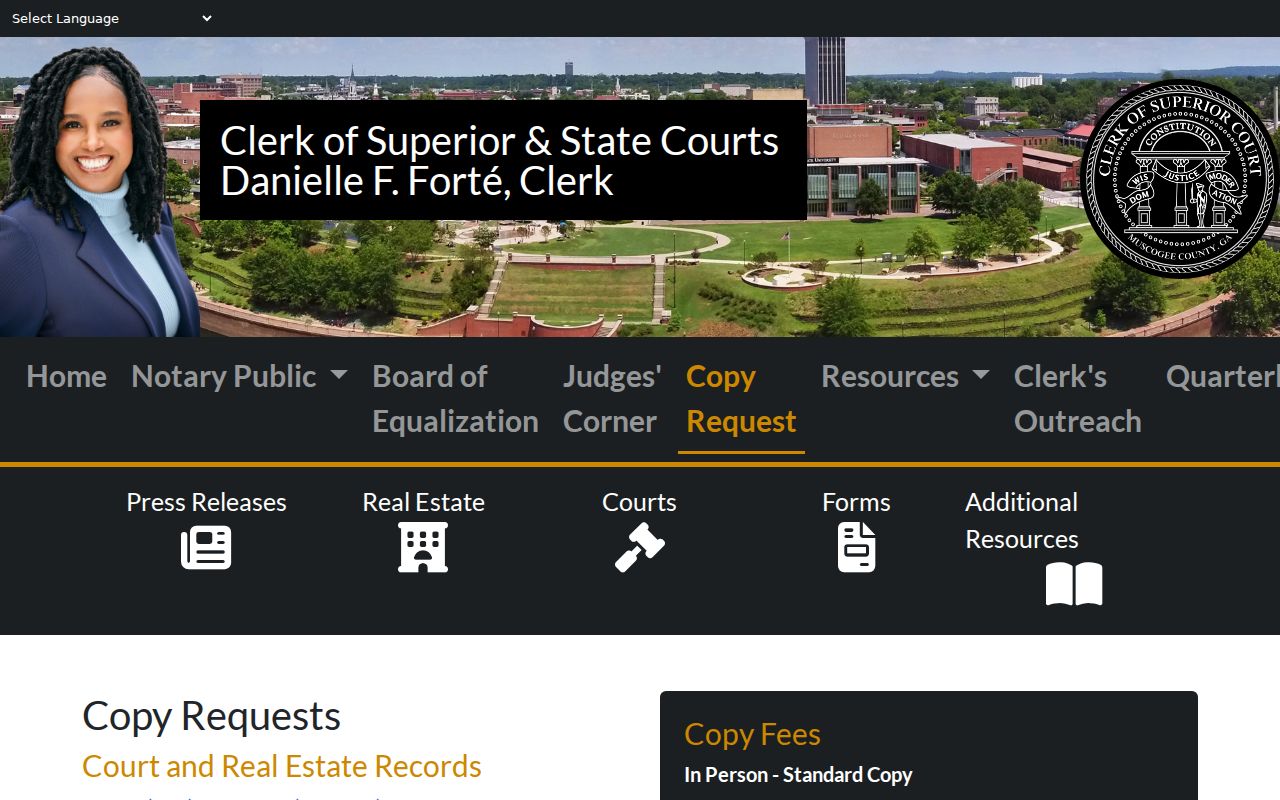
The captured clerk page confirms why a portal result must often be followed by a copy order or counter visit.
Columbus Court Records Beyond eCourt
Muscogee eCourt provides nonconfidential case information for local courts. Superior Court handles felonies, general civil cases, domestic matters, divorce, title, and equity. State Court covers misdemeanors and assigned civil cases. Municipal Court handles civil suits, garnishments, writs, warrant applications, and criminal misdemeanors. Sealed and confidential information does not appear online, and juvenile matters have separate controls.
Georgia Courts E-Access is a directory of providers, not one statewide case database. It may send a user to another system and may require an account. For an actual Muscogee file, a clerk terminal and the copy desk remain the sound fallback. They can also clarify the court division and copy type. A docket is the court's list of case events; it is not the full set of pleadings, orders, and exhibits.
The official Columbus court portal shows the case-information entry point.
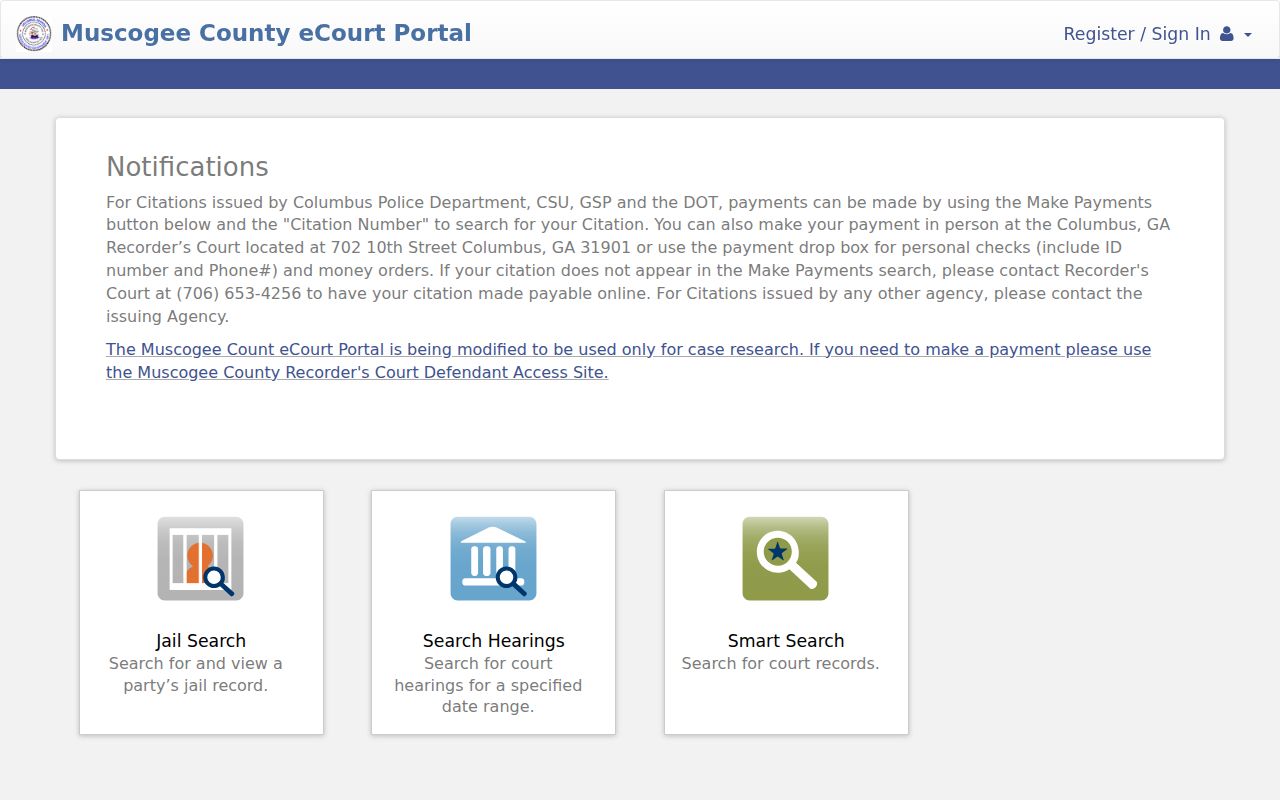
The portal image marks the online starting point, while the clerk remains the source for file inspection and certified copies.
Note: A missing web result does not prove that no case or paper file exists.
Columbus Property Records and Title
The CCG property portal offers Owner, Address, Parcel, Advanced, and Map modes. It draws assessment information from the last certified roll, while other details may change. The assessor maintains owner names, sales, physical features, and the tax digest. Real-property notices go out each May with a 45-day appeal period.
A tax-roll owner is not always the current occupant, and an assessment is not recorded title. The situs address is the physical site. The mailing address is where tax correspondence goes. A parcel is the assessor's stable property identifier, and a plat is a recorded map of land boundaries. To confirm title, carry the owner name and legal description from the assessor record to EagleWeb, then obtain the deed image from the clerk if needed. The GIS viewer can also draw a buffer around a parcel and export a map, which helps identify adjacent owners.
Property warning. Government-looking mail may still be a sales pitch. Columbus officials warned in 2025 about paid offers for free homestead, appeal, and excess-funds services.
Columbus Vital Records Have Limits
Modern vital records do not operate as an open name index. Birth records from 1919 forward are held by Georgia DPH and the local registrar, with certified copies limited to the registrant and specified family or legal representatives. A certified death copy requires a qualifying relationship or tangible interest. The public may order a plain-paper death record with the Social Security number redacted. Probate Court handles marriage records outside DPH's limited state range, and Superior Court holds divorce decrees.
Georgia charges $25 for the first birth or death copy and $5 for additions. An online order adds an $8 processing fee. Mail service is published at eight to ten weeks, while county service may be same-day. Marriage records in DPH's June 28, 1952 through November 27, 1996 range cost $10 for the search and copy, plus $5 for additions. O.C.G.A. Title 31, chapter 10 and Georgia vital-record rules control eligibility.
The Georgia vital records request page compares the available order channels.
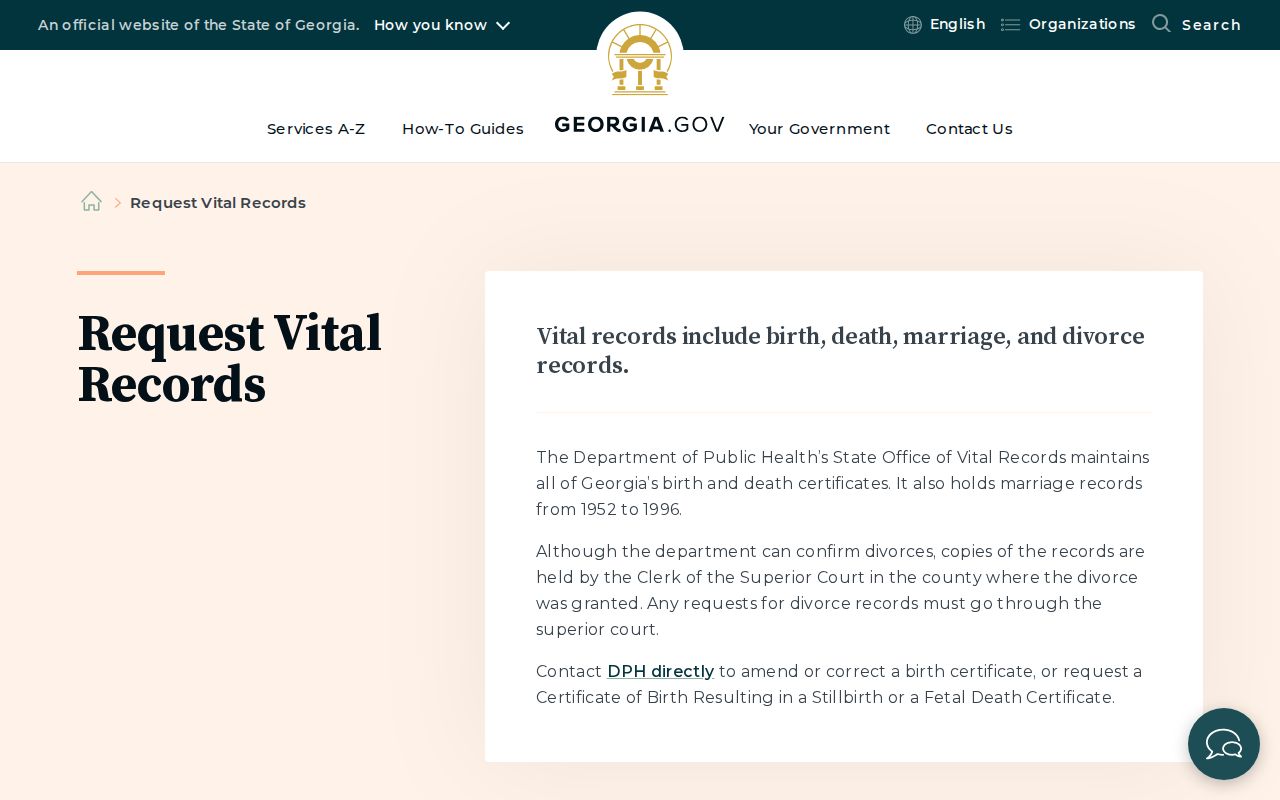
The captured state page reinforces that a certificate request is an identity and eligibility process, not a broad public search.
Columbus Police and Sheriff Records
Law-enforcement records stay with the agency that made them. Columbus Police takes requests online, by email, at Desk Services, or by mail. Readily available material is supplied within three business days, while 911 items may take two to eight weeks. Paper copies cost $0.10 per page plus lawful labor and postage, with the first $2 waived. Estimates and prepayment rules rise with the expected total.
The Muscogee Sheriff accepts records requests by email at mcsoorr@columbusga.org or through its records custodian at 100 10th Street, phone 706-653-4225. No verified live county jail roster was found. Use the Sheriff request route or VINE custody notifications instead of assuming a missing roster means no local custody record. State prisoners appear in the Georgia Department of Corrections query, and the GBI runs the state offender registry.
The Columbus Police request page publishes its time and fee rules.
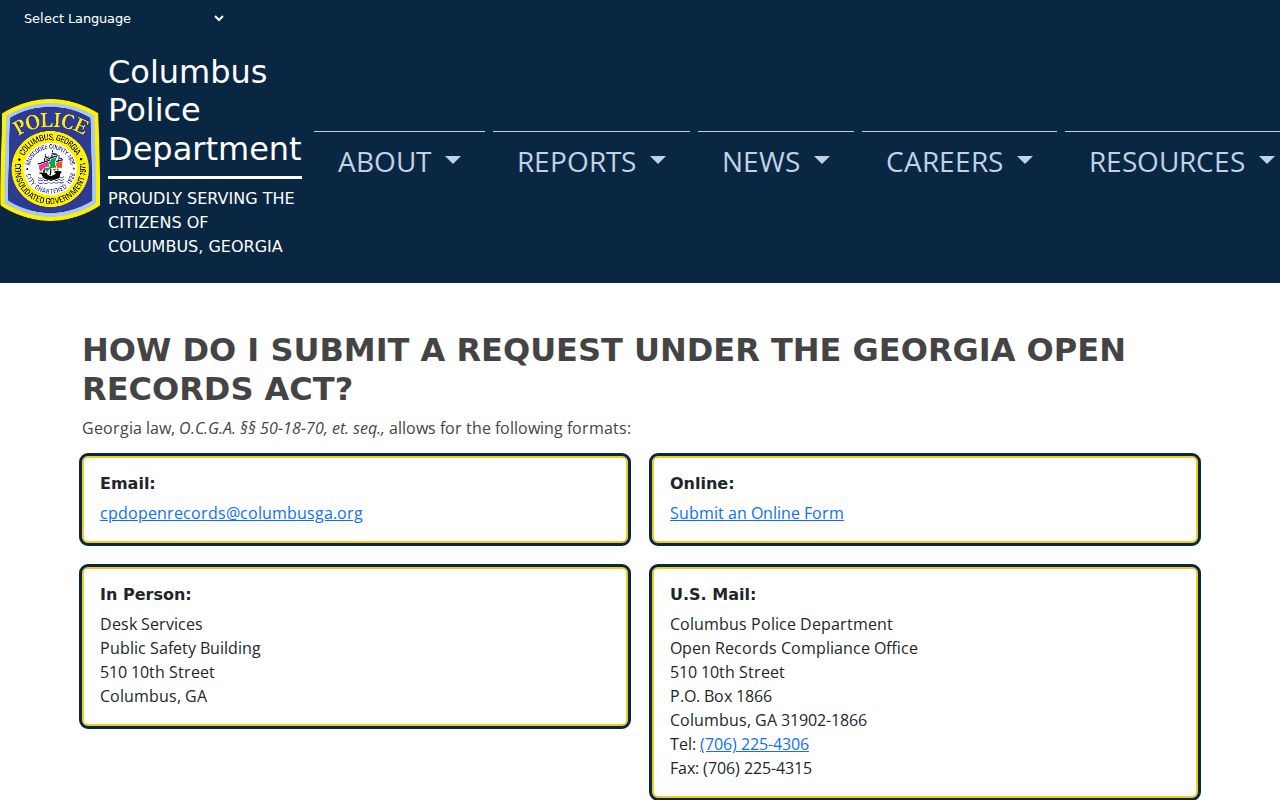
The police screenshot shows why the agency channel, record type, and likely processing time should be checked before submitting.
Columbus Built a Records Center
A regional records initiative began with a 1997 inventory of Columbus government offices. Staff were trained, preservation needs were planned, and a 40,000-cubic-foot center created controlled storage plus public research space. The work later received a 2003 Archives Advocacy Award. That history matters because public access is more than a web portal. Retention, storage, description, and a place to inspect records are all parts of the system.
The project does not prove that every old file survived or is digitized. Wartime destruction affected Columbus industry in 1865, but the reviewed official sources do not support a claim of wholesale courthouse-record loss. For older material, confirm the individual series with the holding office or Georgia Archives rather than assuming one event explains every gap.
Columbus Records Access Terms
A few terms make requests much clearer. Use them when speaking with the custodian, especially when the desired result must be certified or when only part of a file may be withheld.
- Custodian
- The agency or office responsible for keeping and producing the record.
- Index
- A finding aid that identifies a record; it may not include the full image or file.
- Certified copy
- A reproduction formally authenticated by the records office.
- Exemption
- A legal reason that permits an agency to withhold a record or field.
- Redaction
- Removal of a protected field while the rest of the record is released.
Georgia may charge redaction labor after the first 15 minutes at the rate of the lowest-paid qualified worker. If an office withholds material, ask for the exact exemption citation and whether a redacted version can be released.
Request Columbus Public Records
Under the Georgia Open Records Act, an agency must produce available, nonexempt records within three business days. If production cannot occur in that period, the agency must state when the records will be ready, give an estimated cost, and cite the precise exemption for withheld material. Electronic records should be supplied electronically when practical, using the most economical means.
- Identify the office that created or keeps the record. A broad request sent to the wrong Columbus desk costs time.
- Check the official index, then note names, dates, case numbers, parcel IDs, or instrument references that narrow the request.
- Submit through the office's published portal, email, mail, or counter channel. Ask for an electronic format when it meets the need.
- Review the estimate. Narrow the date range or record type if labor and copy costs are high, then pay any required deposit.
- If material is withheld, request the exact statutory citation and a redacted release. The Attorney General open-government process and Superior Court remedies remain available.
Lawful use. Open access supports civic review and lawful personal research. Never use Columbus records to stalk, harass, threaten, or harm another person.
Keep a copy of the request and response. A short, precise request is easier to price and process than a demand for every item tied to a person. When the office identifies an exemption, ask whether nonexempt pages or fields can be separated and released.