
Begin a Columbus People Search
Choose the first Columbus record by what is already known. A street address points to the CCG Public Access property roll. A party name tied to a dispute belongs in Muscogee eCourt. A former resident may appear in an old city directory, obituary index, or deed. Probate records are often best for heirs and estate representatives. The Georgia business registry and professional license search can connect a name with a firm, registered agent, or licensed occupation.
One source rarely proves identity by itself. Names repeat, owner mailing addresses can differ from property addresses, and a tax-roll owner may not occupy the parcel. Record the middle initial, date, parcel number, relatives, or business role shown by the first result. Then test that detail against a second official source. Use this order as a practical Columbus people lookup:
- Search the property roll by owner or address and save the parcel ID, legal description, and separate situs and mailing addresses.
- Check EagleWeb for a deed, lien, or plat tied to the name, then use the clerk terminal when the web index is incomplete.
- Search Muscogee eCourt for nonconfidential case information and ask the proper court clerk for the actual file or certified copy.
- For older family links, use the library's marriage, birth, death, obituary, newspaper, and city-directory collections.
- If no portal holds the needed record, identify the office that created it and send a narrow Georgia Open Records Act request.
Use Columbus records only for lawful personal research. Never use a name, address, or family connection to stalk, harass, or harm someone.
Columbus Records Offices by Role
Consolidation does not put every Columbus people record behind one counter. The Clerk of Superior and State Courts records real estate instruments and keeps Superior and State court files. Probate Court handles estates, wills, guardianships, and marriage licensing. The Tax Assessor maintains the ownership roll and parcel facts. Police, the sheriff, elections staff, and the health department keep records created by their own work. The detailed request rules and copy choices belong with the Columbus public records system.
Muscogee Probate Court
Government Center, sixth floor
Columbus, GA
706-225-4333
Follow Columbus Names Through EagleWeb
The Muscogee County Clerk's recorded-document index connects names with deeds, liens, and plats. A deed names a grantor, the person or entity transferring an interest, and a grantee, the recipient. The index was current through July 14, 2026 when researched, but the clerk does not publish the first online year. Late-1800s holdings are stated. For an older Columbus people search, do not assume that a missing online hit means no document exists.
The official EagleWeb entry page requires cookies and JavaScript and offers guest access through an acknowledgment. The post-acknowledgment fields were session-blocked during research, so no unverified field list belongs here. The screenshot shows the actual entry surface and its current-through notice.
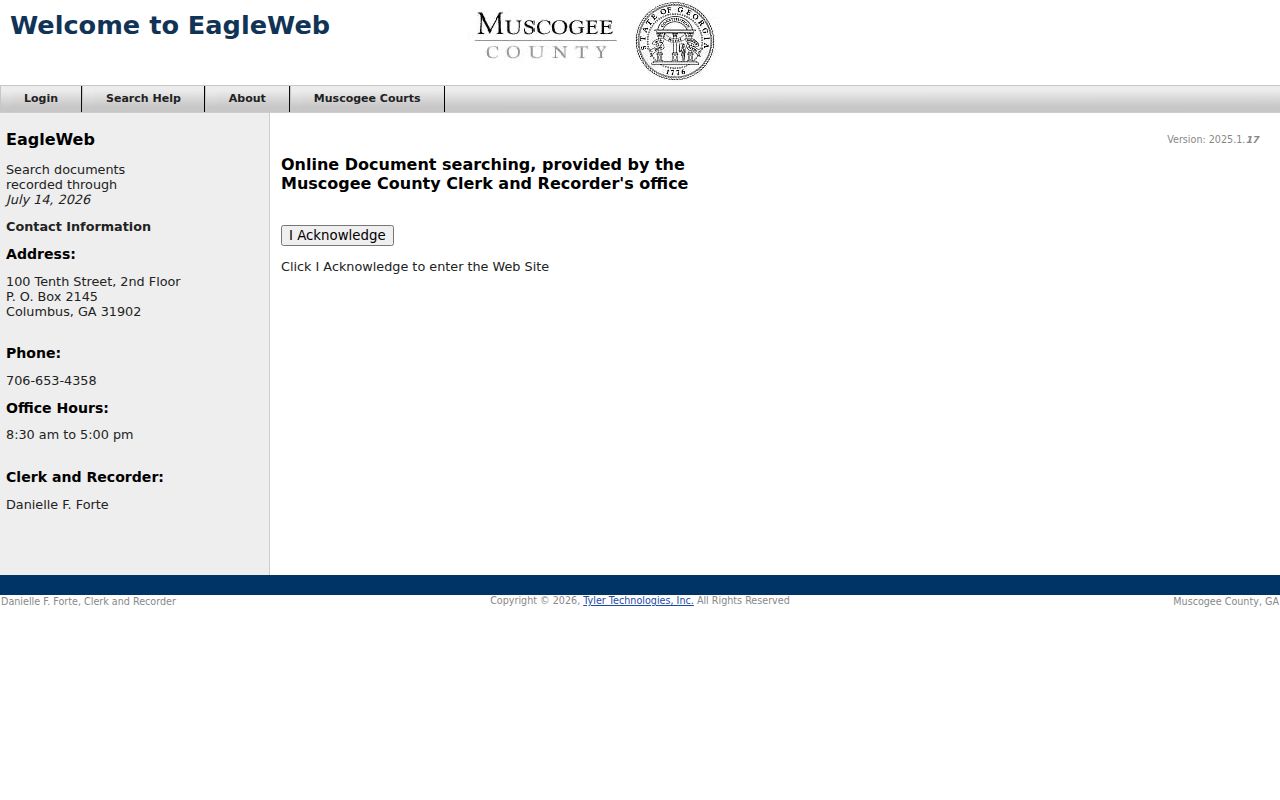
When EagleWeb stops at an index entry, the deputy counter and public terminal are the fastest fallback. Ask for an ordinary or certified copy by document reference rather than expecting the index screen itself to prove title.
- Index
- A finding aid that points to a record; it is not always the full image.
- Grantor
- The party transferring an interest in a recorded instrument.
- Grantee
- The party receiving that interest.
- Certified copy
- A copy authenticated by the office that keeps the record.
Search Columbus Owners and Parcels
The assessor is often the quickest bridge from a Columbus address to a name. CCG Public Access offers Owner, Address, Parcel, Advanced, and Map modes. Its data comes from the last certified roll, while other details may change. Save the parcel ID and legal description with the owner name. Those keys help distinguish similar addresses and lead into the deed index.
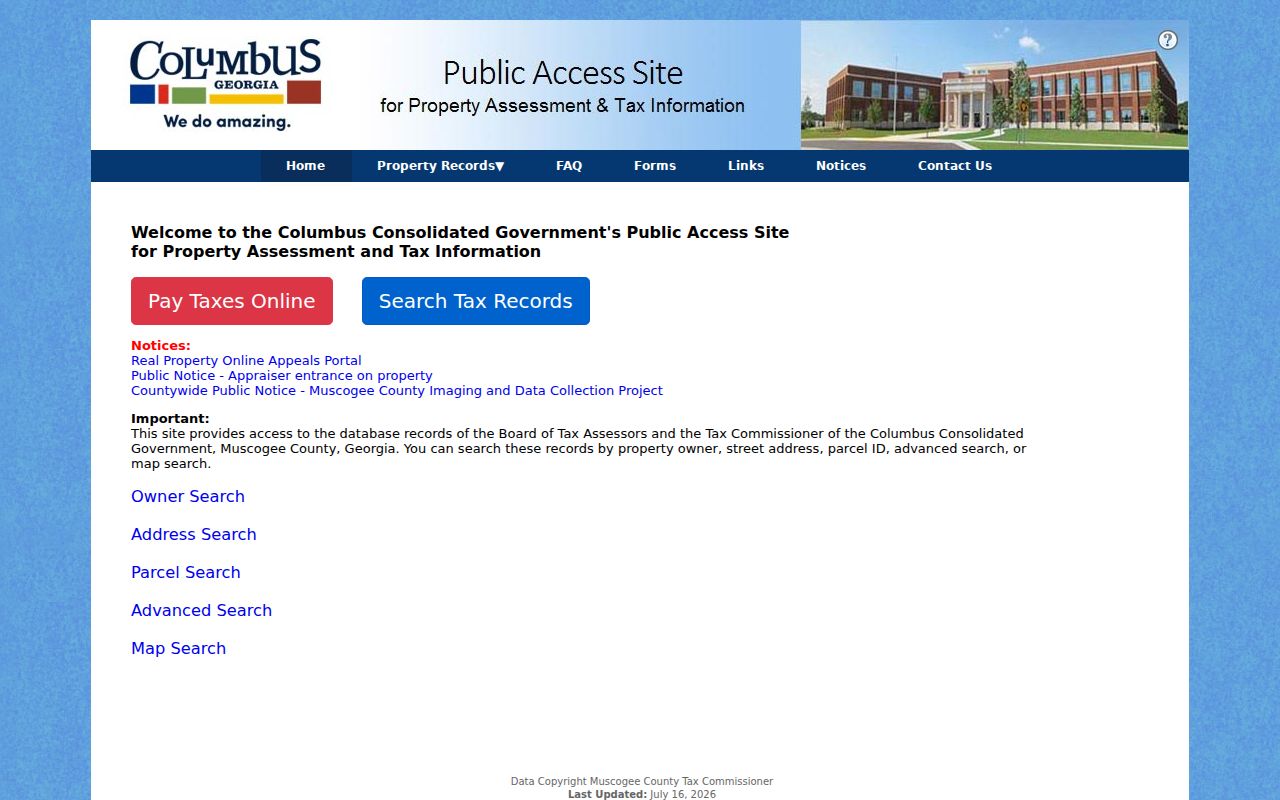
The assessor screen makes each route visible, but its owner is not proof of who lives there. A situs address is the physical parcel location. A mailing address is where assessment notices go. They may differ for many lawful reasons. Treat the roll as one step, then confirm an ownership transfer in EagleWeb or ask the clerk for the document.
| Known fact | Columbus search | Useful result |
|---|---|---|
| Owner name | Owner mode | Parcel and mailing details |
| Street address | Address mode | Owner and legal description |
| Parcel ID | Parcel mode | Stable local property match |
| Nearby site | Map mode | Adjoining parcel context |
Map a Columbus Address Trail
The CCG parcel GIS adds geography to the assessor result. Its verified controls include parcel-ID search, point and polygon tools, a buffer measured in feet or meters, layer selection, and print or export choices. A buffer can reveal adjoining parcels when a family, estate, or business held several nearby lots. It can also expose an address spelling that differs from the one in old papers.
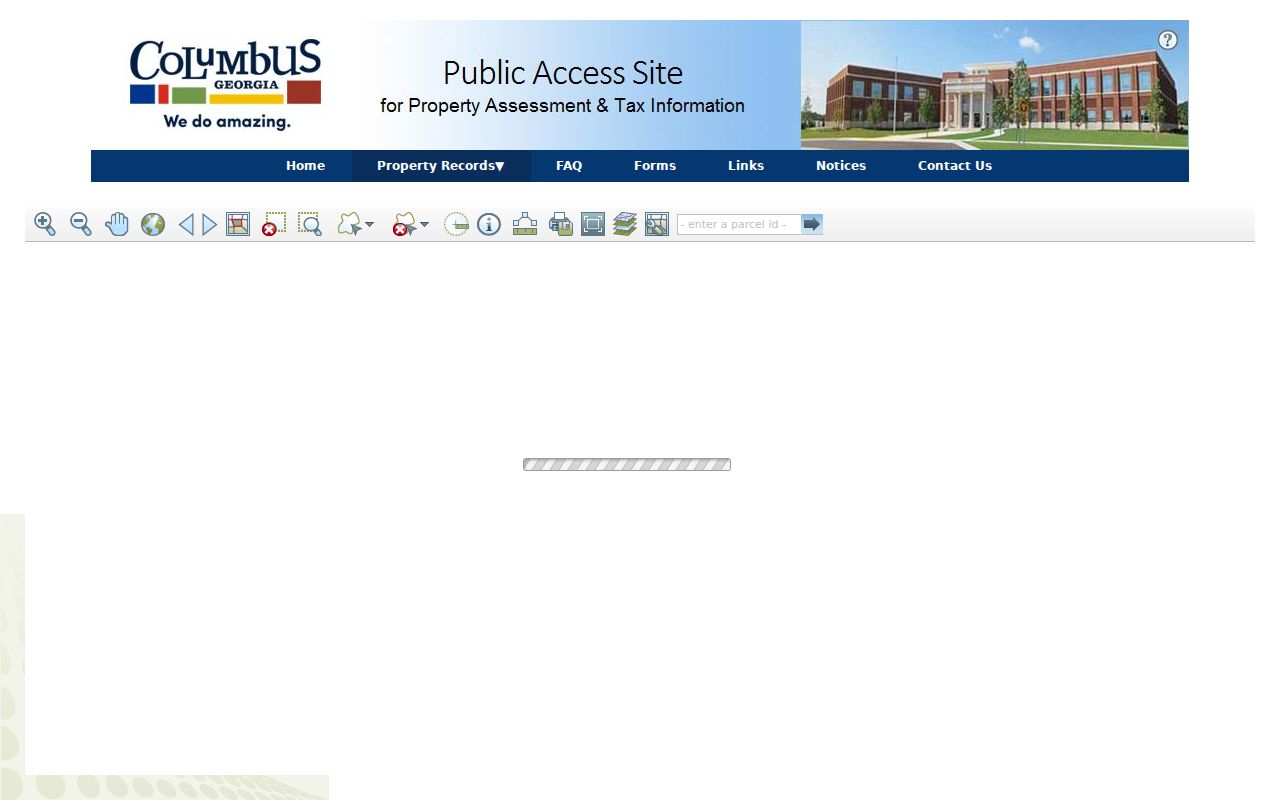
Use a map result as a locator, not a conclusion. The clean workflow is address to parcel, parcel to owner and legal description, legal description to the latest deed, and grantee name to earlier instruments. For an old address, add a city directory or survey. Columbus and Muscogee share a government, but the metro crosses the Chattahoochee into Phenix City, Alabama, so a person can vanish from a Georgia source after a very short move.
Note: Parcel boundaries and owner rows aid a search, but the recorded instrument is the stronger source for a transfer of title.
Check Columbus Court Records by Name
Muscogee eCourt provides nonconfidential case information for the local courts. It is a starting point, not the actual case file. The researched page did not expose stable search fields or a sample docket because the application is dynamic. Georgia's E-Access service is also a provider directory, not one universal statewide court database. It routes a user to a participating system, and an account may be needed.
Match the dispute to the court. Superior Court handles felonies, divorce, title, equity, and general civil cases. State Court handles misdemeanors and assigned civil matters. Municipal Court holds dispossessory cases, garnishments, warrant applications, and misdemeanors. Probate Court keeps estates and guardianships. Juvenile and sealed records remain controlled. For the true file, an omitted document, or certification, use the proper clerk's terminal and copy desk.
| Court | Covers | Name Search | Access |
|---|---|---|---|
| Superior Court | Felony, divorce, title, general civil | Muscogee eCourt | Portal, terminal, copy desk |
| State Court | Misdemeanor and assigned civil | Muscogee eCourt | Portal, terminal, copy desk |
| Municipal Court | Civil, garnishment, warrants, misdemeanor | eCourt link | Portal and local clerk |
| Probate Court | Estates, wills, guardianship | No verified party portal | Office examination |
| Middle District of Georgia | Federal civil and criminal | PACER | Paid online or federal clerk |
Locate Columbus Vital Records
Modern birth and death records run through the Muscogee County Health Department or Georgia Department of Public Health. Birth copies are limited to the registrant and specified family or legal representatives. A certified death copy requires a qualifying relationship or tangible interest, while the public may order a plain-paper death record with the Social Security number redacted. The base state fee is $25 for the first birth or death copy and $5 for added copies in the same order.
Marriage custody depends on the date. Georgia DPH covers June 28, 1952 through November 27, 1996. Probate Court handles other local marriage years, and Superior Court keeps divorce decrees. The marriage record is public, but the application is restricted to the spouses. Requests can go online, by mail, or to a local counter where offered. State mail service is published at eight to ten weeks, while county service may be same-day.
Older Columbus people records have a strong library trail. Municipal birth registration began in August 1890, well before statewide registration in 1919. The Columbus Public Library indexes marriages from 1835, births from 1890, and early deaths and obituaries. These are search aids; order any certified record from its legal custodian.
Bridge Columbus Generations at CVL
The Columbus Public Library's Genealogy and Local History room provides the best fallback when a modern portal cannot reach an earlier generation. Its named local tools include a Death Register for 1800 through 1899, the Enquirer-Sun Death Index for 1900 through 1918, a Marriage Index for 1835 through 1929, and birth indexes and registers from 1890 through 1918. Obituaries, maps, military records, vertical files, and census tools can add relatives and former addresses.
The CVL genealogy collection page identifies the onsite and database choices. Ancestry Library Edition is onsite only, MyHeritage is available through GALILEO, and FamilySearch affiliate access may unlock restricted images.
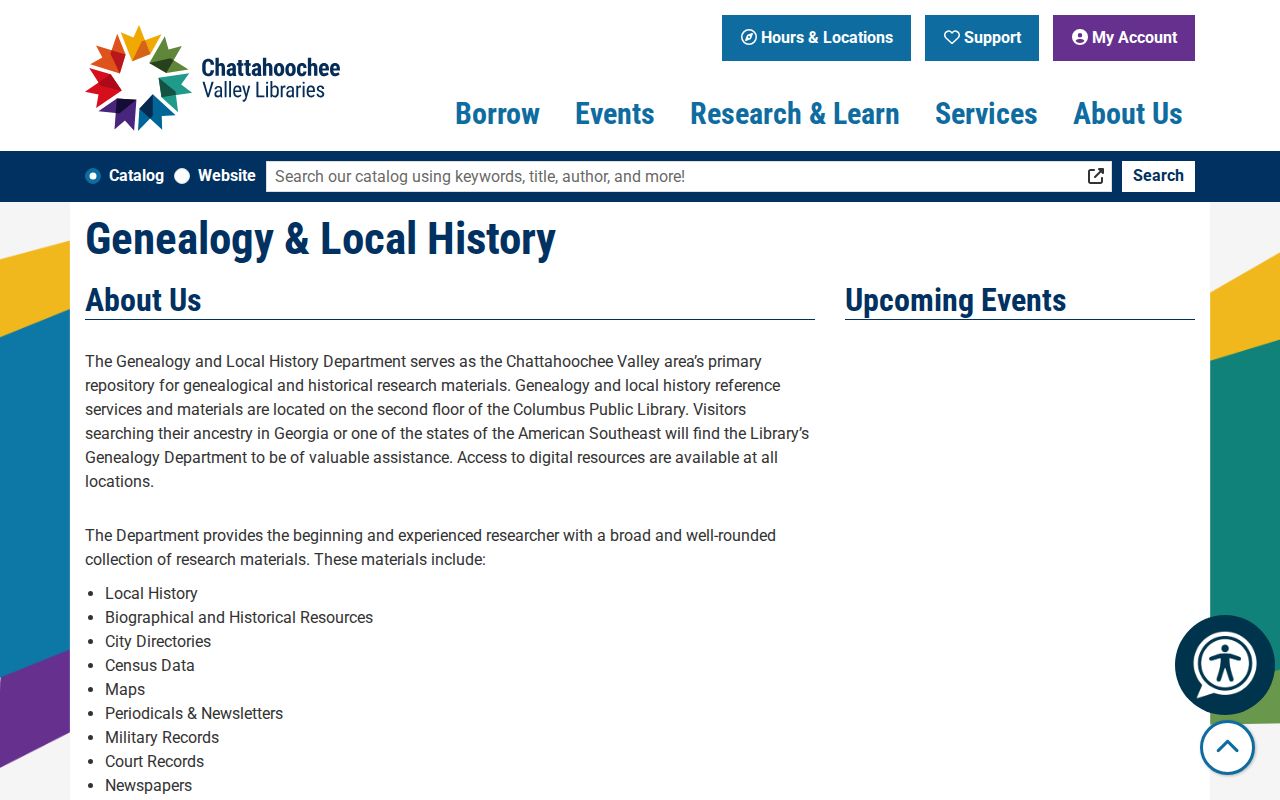
The library screen is only the entry point. Staff can help locate microfilm and a written document request includes up to one hour of research and five photocopies, though the current dollar fee was not visible in the researched source. The room is on the second floor at 3000 Macon Road and can be reached at 706-243-2681.
Browse Early Columbus People Directories
The Digital Library of Georgia Columbus directories cover 1859 through 1912. Their alphabetical pages can show a resident's name, occupation, residence, business, church, school, or public office. OCR text is not corrected, so retry a surname with initials, spelling variants, and old abbreviations such as res for residence, bds for boards, wid for widow, and lab for laborer.
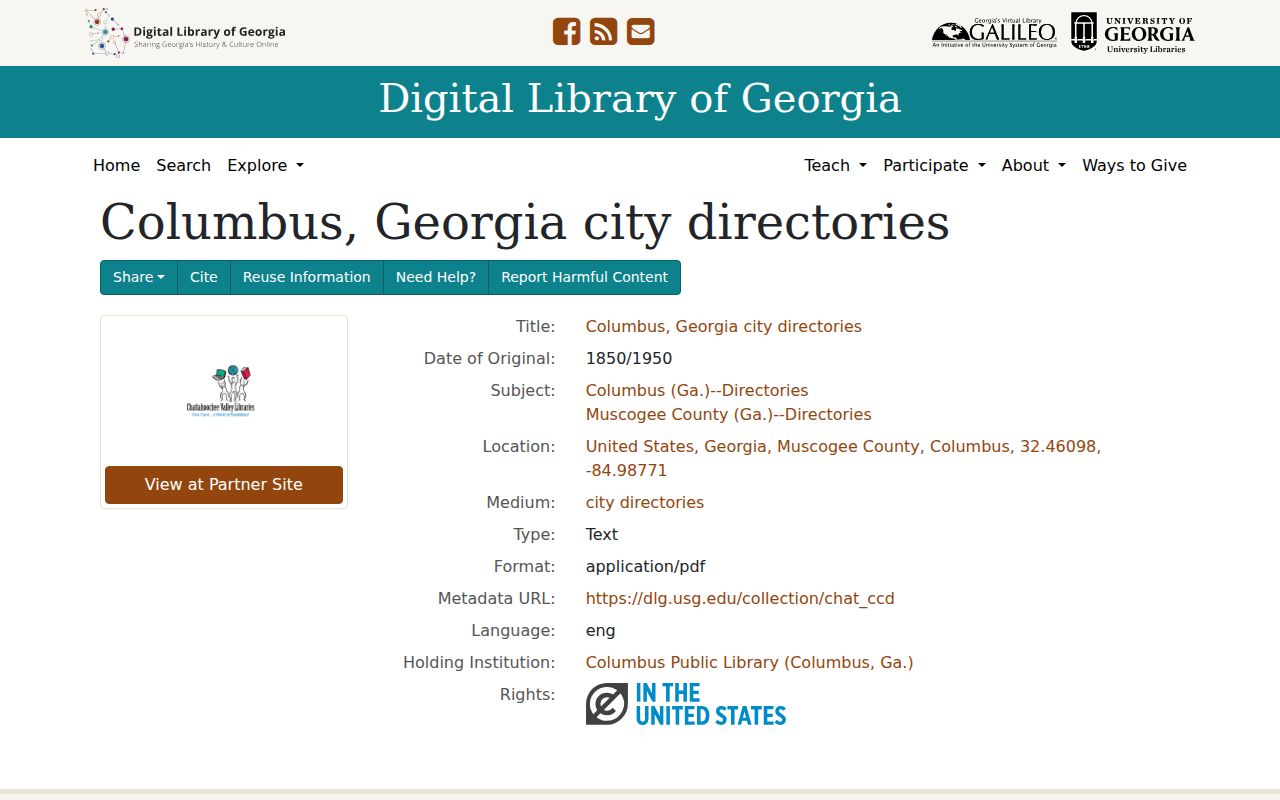
The 1894 Zorn directory is especially useful because it crosses the river into Phenix City and Girard and includes a Muscogee landowner list. That local quirk matters. A name that disappears from a Columbus volume may have moved across the Chattahoochee while remaining in the same social and work network. The dedicated Columbus people directories page compares current, property, professional, and historic sources.
Trace Columbus News and Photo Records
Newspapers can join a name with a date, street, relative, firm, club, military unit, or court event. The Digital Library of Georgia's searchable Columbus Enquirer spans 1828 through 1890 and contains more than 32,000 pages. CVL adds Georgia Historic Newspapers, a Ledger-Enquirer database from 1993 to the present, and local death and obituary indexes. Search a narrow date first, then test initials and spelling variants.
Columbus State University Archives holds about 76,000 Ledger-Enquirer photo prints from the early 1900s through 2002, plus surveys, city and telephone directories, government reports, and oral histories. Neighborhood and community collections cover Carver Heights, MidTown, Wynnton Road, mill workers, military life, and residents often missed by formal rolls. A caption or oral-history transcript may solve an identity that a property or court index leaves unclear.
Note: A newspaper mention is evidence of an event, not automatic proof that two people with the same name are one person.
Use Columbus Custody Lookups Carefully
No verified live Muscogee County jail roster was found. Start with the Muscogee County Sheriff's records channel, VINE custody notifications, the Georgia Department of Corrections offender query, or the federal Bureau of Prisons locator, depending on the agency involved. VINE is free and can send phone, text, or email alerts; calls use a four-digit PIN. A state-prison result does not describe local jail custody.
The Georgia Bureau of Investigation registry is the authoritative state sex-offender search.
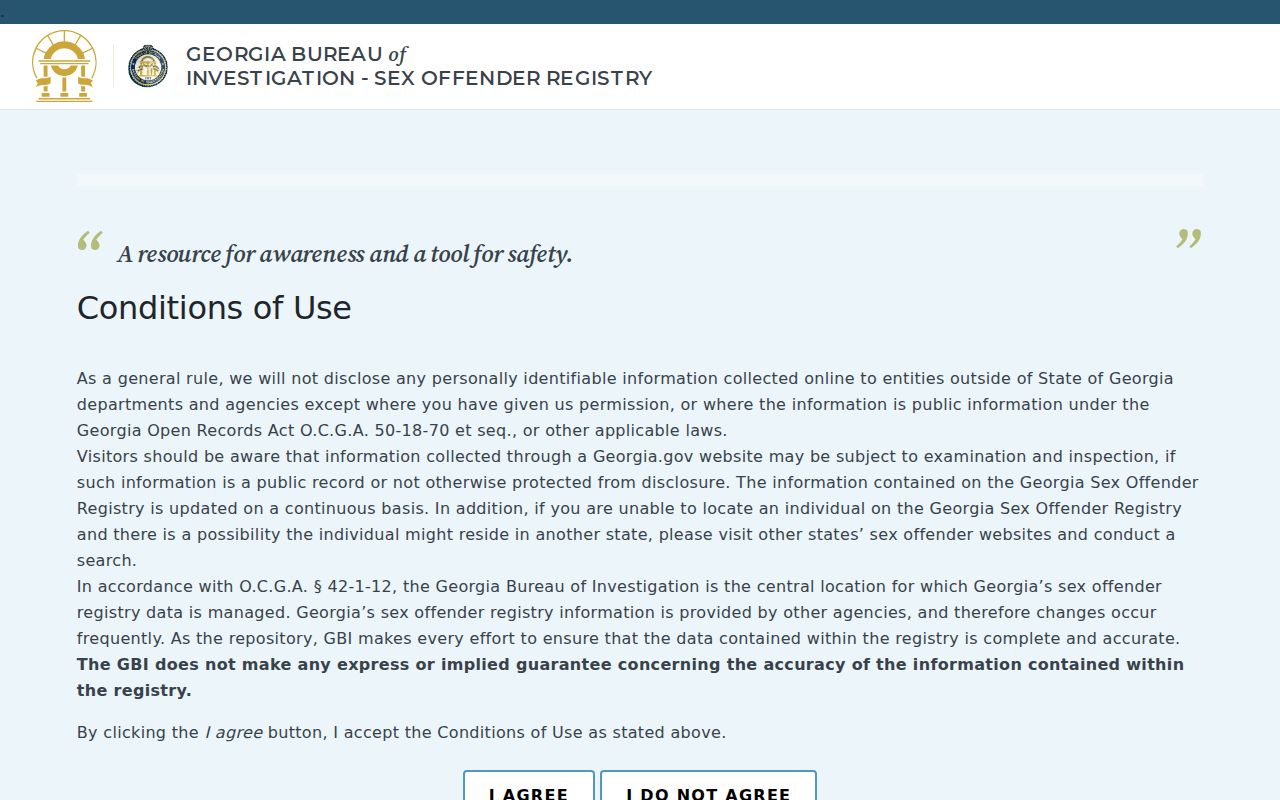
The screen shows the official search surface, but matches require care. Confirm identity through the agency and follow every stated use limit. For Columbus Police incidents, request online or by email, mail, or the Desk Services counter. Ask the creating agency rather than sending one broad request to the consolidated government.
Verify Columbus People Across Sources
Official indexes serve different roles. The assessor identifies the owner on the latest certified roll. EagleWeb points to recorded instruments. eCourt displays nonconfidential case information. A library directory records what a publisher printed in a given year. Commercial people-finder data may combine public and private sources, can lag behind changes, and may merge two similar names. It should never replace a custodian's record.
| Source type | Best use | Main limit |
|---|---|---|
| Official online index | Fast name or parcel lead | May omit images or older years |
| Clerk terminal or copy desk | Actual file and certification | Office process and copy fees |
| Library or archive | Historic residents and family links | Coverage varies by collection |
| Commercial compilation | Possible broad lead | Stale or wrongly merged data |
Finish a Columbus people search by preserving the source URL, office, date checked, and record reference. If a portal gives no result, try the counter, mail route, archive, or a focused request. The Georgia Open Records Act calls for available nonexempt records within three business days, or a timely statement of availability, estimated cost, and any exact exemption relied on. Narrow dates and identifiers reduce both false matches and request cost.
A good match should explain why the records belong to the same person. Compare middle initials, relatives, dates, business roles, parcel descriptions, and the source's own time period. Keep conflicting facts instead of discarding them. They may show a move, a remarriage, a name variant, or two different residents. For older Columbus research, move in small steps from a dated directory entry to a newspaper notice, deed, probate file, cemetery record, or oral history. For a current official fact, return to the agency that creates and maintains it. This method keeps a Columbus people lookup tied to evidence rather than a convenient but weak name match.